Are Big Investors Buying Up All the Homes in Portland & Vancouver?
Are Big Investors Buying Up All the Homes in Portland & Vancouver?

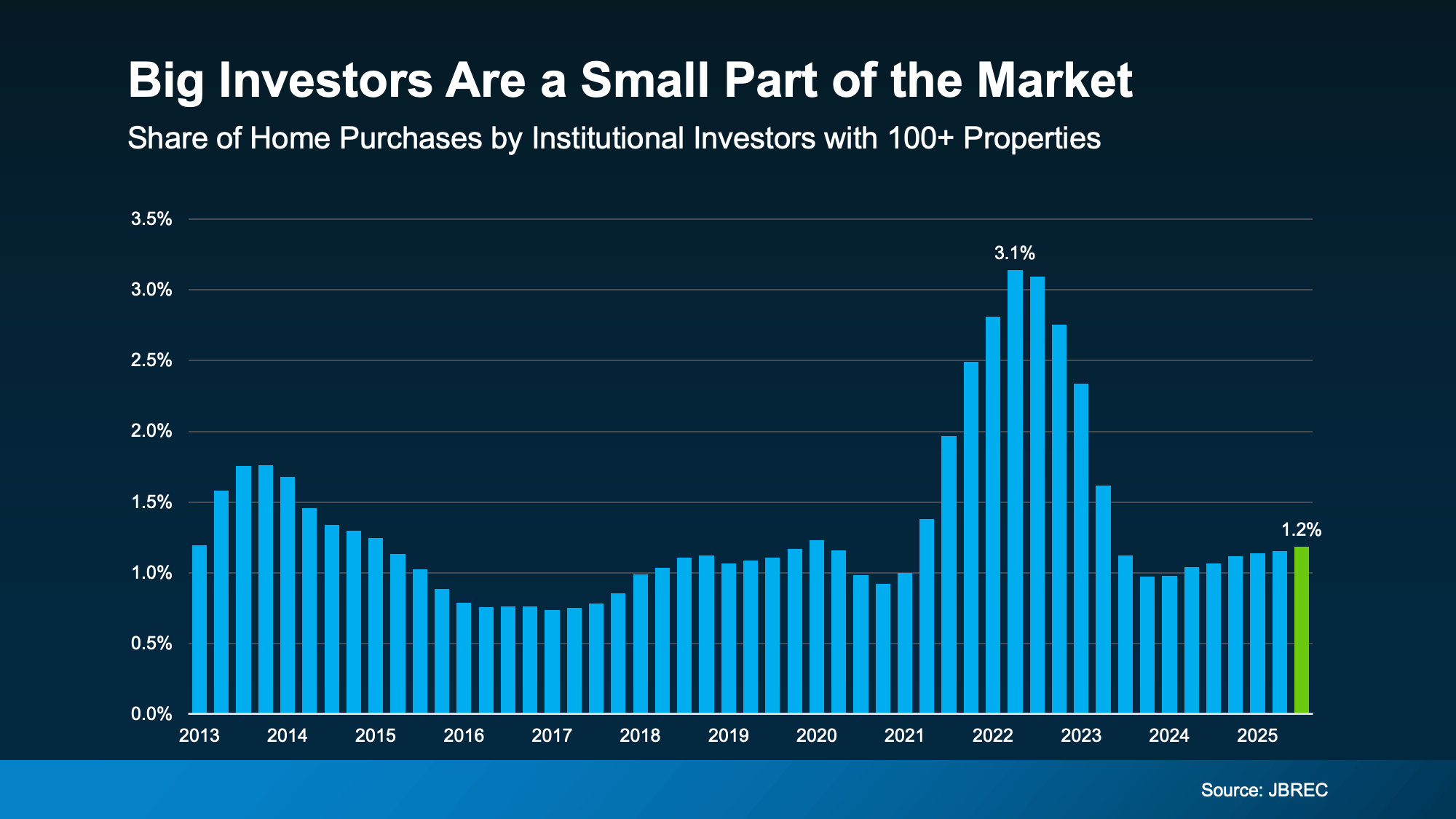
Key Takeaway: No, large institutional investors are not "buying up all the homes." In late 2025 and early 2026, data from John Burns Research & Consulting (JBREC) shows that large institutional firms—those owning 100+ properties—accounted for only 1.2% of all home purchases. In the Portland-Vancouver metro, this share is even lower, as local geography and varied architecture make our market less attractive to Wall Street algorithms than "cookie-cutter" Sunbelt regions.
Next Step for You: Since inventory is the bigger factor, would you like me to send you a "2026 Inventory Heat Map"? It shows exactly which neighborhoods in Vancouver and Portland have the most homes for sale right now, so you can find the areas with the least amount of competition!
What percentage of homes are bought by big investors in 2026?
Nationally, the headline-grabbing "Wall Street Landlords" are a small fraction of the market. While total investor activity (including small, local "mom-and-pop" landlords) sits around 17-18%, the large institutions make up just 1.2% of purchases.
Why the PNW is "Investor-Resistant"
Large institutional firms prefer high-volume, uniform subdivisions where every home is nearly identical. The Portland and Vancouver markets are different:
-
Diverse Architecture: Our neighborhoods—from Camas ranches to NE Portland Craftsman homes—require local knowledge that algorithms can't easily replicate.
-
Strong Regulation: High-cost, high-regulation markets like Oregon and Washington often cause large-scale corporate investors to look toward the Sunbelt instead.
-
Local Competition: In our area, you are far more likely to compete with another local family or a small-scale landlord (owning 1-2 homes) than a billionaire hedge fund.
 Why does it feel like investors are taking over the market?
The gap between the "headlines" and the "data" exists for two main reasons:
-
Lumping Categories Together: Headlines often group "Investors" into one big number. This includes your neighbor who bought a second home to rent out, local builders, and "fix-and-flip" renovators. Small investors (1-9 properties) actually make up the vast majority of the investor share.
-
Regional Concentration: Investors tend to target specific lower-priced zip codes. If you are shopping in a very narrow price bracket, you may feel their presence more, but they are not dominating the overall Vancouver or Portland landscape.
What is the biggest challenge for 2026 buyers?
The real challenge in the 2026 market isn't corporate competition—it’s Supply and Demand.
-
The "Lock-In" Effect: Many local homeowners are holding onto 3% interest rates, which has kept inventory tight for the last three years.
-
Underbuilding: A decade of slow construction in the Portland-Vancouver metro has created a deficit of available homes.
-
Good News: As rates stabilize in the low 6s, we are seeing a "Market Thaw." Local inventory is up 9% year-over-year, giving buyers more breathing room than they’ve had since 2021.
Bottom Line: Focus on the Facts, Not the Noise
Don't let the fear of "Big Investors" keep you on the sidelines. The data shows that the Portland-Vancouver market is still driven by people, not corporations. At Lucido Global, our Top 20% team has helped over 1,000 families navigate this competition over the last 20 years. We know how to position your offer to win against any buyer.
Curious about the actual competition in your favorite neighborhood? Let’s connect for a real-time market report on Camas, Ridgefield, Hillsboro, or Portland.
Lucido Global Team Portland / Vancouver Phone: 360.609.0226 Email: KenRosengren@LucidoGlobal.com
#RealEstateTruths #PortlandRealEstate #VancouverWA #Top20PercentAgent #LucidoGlobal #HousingMarket2026 #MarketLeaderPDX #VancouverWAHomes #PortlandORRealtor #RealEstateExpert #CamasWA #RidgefieldWA #HomeBuyerEducation #PremierAgent
Categories
- All Blogs (655)
- For Sale By Owner (21)
- Local Events (39)
- Portland Metro (2)
- 100 Hands for Foster Care (2)
- 1031 Exchange PNW (1)
- Affordability (69)
- Agent Value (105)
- Battle Ground (2)
- Boutique Neighborhoods (1)
- Brush Prairie WA (1)
- Buying Tips (233)
- Camas High Schools (1)
- Camas WA (1)
- Camas WA Home Buying (1)
- Camas WA Real Estate (2)
- Central Hub (1)
- Clark County Housing (25)
- Clark County WA Schools (3)
- Closing Costs (1)
- Community Support (17)
- Cowlitz County (1)
- Credit Tips (2)
- Debt-Free Living, (1)
- Design (8)
- Downsize (13)
- Downsizing Vancouver WA (12)
- Economy (28)
- Equity (37)
- Evergreen High Schools (1)
- Expired Listings (1)
- Featured (20)
- Felida WA Home Buying (1)
- Felida WA Real Estate (1)
- Financial Planning (43)
- First-Time Home Buyer (194)
- For Investors (1)
- For Sale by Owner (6)
- Forecasts (17)
- Foreclosures (6)
- Foster Care Resrources (2)
- Fun Tips (10)
- Giving Back (1)
- Historic Charm (1)
- Historical Character (1)
- Hockinson WA (1)
- Home Buying (299)
- Home Improvement (1)
- Home Inspections (3)
- Home Prep & Staging (5)
- Home Prices (77)
- Home Selling (206)
- Home Staging PNW (1)
- Home Value (10)
- Housing Market Confidence (43)
- Independent Living PNW (2)
- Inventory (40)
- Kalama WA (1)
- La Center (1)
- Landlord Tips (2)
- Lifestyle Move PNW (24)
- Listing Strategy (5)
- Local (102)
- Local Non-Profits (1)
- Longview WA (1)
- Luxury / Vacation (7)
- Market Update (66)
- Mid-Tier Housing (1)
- Mortgage (71)
- Move-Up (16)
- Moving for Job Relocation (5)
- Multi-Generational (1)
- Negotiation Strategy (4)
- New Construction (15)
- Newsletter (14)
- Open House (1)
- Portland Downsizing (10)
- Portland For Sale by Owner (1)
- Portland OR (9)
- Portland OR Affordability (39)
- Portland OR Home Buying (84)
- Portland OR Homes (9)
- Portland OR Real Estate (119)
- Portland OR Seller Tips (37)
- Portland Real Estate FAQs (10)
- Portland Recession Risk (1)
- Portland-Vancouver Home Value (13)
- Portland-Vancouver Inventory (10)
- Price It Right Portland (8)
- Real Estate Investing (8)
- Real Estate Tax Strategy (1)
- Rent vs Buy (19)
- Restaurant Reviews (5)
- Retirement Planning (2)
- Ridgefield WA (1)
- Ridgefield WA Home Buying (1)
- Rightsizing Vancouver WA (3)
- Seasonal (11)
- Selling Rental Property (2)
- selling tips (139)
- Senior Market (6)
- Silver Group (3)
- Suburban Living (3)
- Technology (1)
- Teens & Young Adults (11)
- Trends (15)
- Vancouver For Sale by Owner (2)
- Vancouver WA (9)
- Vancouver WA Affordability (34)
- Vancouver WA Home Buying (71)
- Vancouver WA Home Value (7)
- Vancouver WA Real Estate (121)
- Vancouver WA Selling Tips (37)
- Washougal WA (1)
- Wealth Building (19)
- Yacolt WA (1)
Recent Posts